
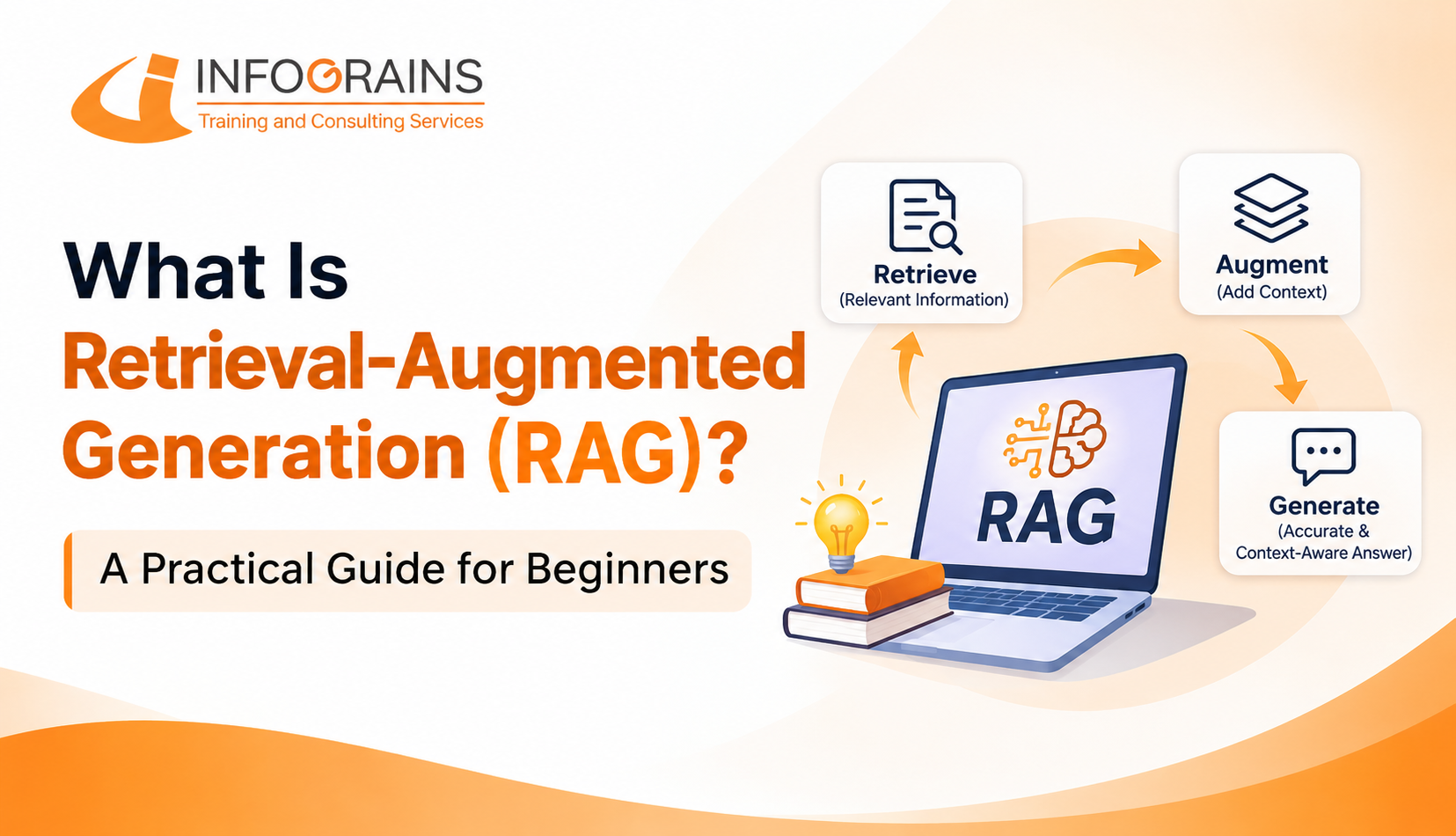
What Is Retrieval-Augmented Generation (RAG)? A Practical Guide for Beginners
Large language models are brilliant but forgetful, and sometimes confidently wrong. Retrieval-Augmented Generation (RAG) fixes that by letting the model look things up before it answers. This guide explains how RAG works, what its architecture looks like, how it compares with fine-tuning, and how to build your first RAG application in Python.
What Is Retrieval-Augmented Generation (RAG)?
The short answer for beginners, then the slightly longer one.
If you are searching for "what is RAG in AI", the easiest mental model is an open-book exam. A plain LLM is a student who studied hard months ago and must answer from memory. A RAG system is the same student, except they are allowed to flip through the right pages of a textbook before writing each answer. The student's skill (language and reasoning) did not change. What changed is access to fresh, relevant facts at the moment of answering.
The technique was introduced in a 2020 research paper from Facebook AI Research (now Meta AI) and has since become one of the most widely used patterns in generative AI. Whenever a company says its chatbot "answers from our own documents", there is very likely a RAG pipeline behind it.
Retrieval
Find the passages most relevant to the question from an external knowledge base, usually by meaning rather than exact keywords.
Generation
The LLM writes a fluent answer using those passages as context, ideally pointing back to where the facts came from.
Why Is RAG Used in Generative AI?
RAG exists because of four stubborn limitations of standalone language models.
1. Knowledge has a cut-off date
An LLM only knows what was in its training data. Ask about last week's policy change or a product released after training and it simply cannot know.
2. Hallucinations
When a model lacks facts it may still produce a confident, plausible and wrong answer. Supplying real source text reduces that risk, though it does not remove it.
3. Private data is invisible
Your HR handbook, course material, support tickets or codebase were never in the public training set. RAG is how a general model gets access to them.
4. Retraining is expensive
Updating a model's knowledge by retraining is slow and costly. Updating a document in a RAG knowledge base is as simple as re-indexing a file.
This is also how RAG improves AI-generated answers: the model is steered toward evidence that is relevant, recent and specific to the question, and the system can show citations so a human can check the claim. If you want broader context on how AI is reshaping software work, read our post on how AI is transforming web development in 2026.
How Does RAG Work? Step-by-Step Guide to Retrieval-Augmented Generation
Click through the pipeline, or press play and watch it run. Each step shows what happens to a sample question.
Notice that there are really two phases. The indexing phase (steps 1 to 2) happens ahead of time: documents are cleaned, split into chunks, converted to embeddings and stored. The query phase (steps 3 to 6) happens every time a user asks something. Understanding that split is the single most useful idea for anyone starting RAG development.
RAG Architecture Explained With Examples
Hover or tap a card to flip it. The front names the component, the back gives a concrete example.
Knowledge source
PDFs, web pages, wikis, databases.
Example
A university's 300-page student handbook and course PDFs.Chunker
Splits documents into passages.
Example
Cut each page into ~200-word pieces with a small overlap so sentences are not severed.Embedding model
Turns text into vectors of numbers.
Example
"Refund within 7 days" and "money back in a week" land close together in vector space.Vector database
Stores and searches embeddings.
Example
Chroma, FAISS, Pinecone, Qdrant or pgvector return the nearest chunks in milliseconds.Retriever
Finds the top-k relevant chunks.
Example
Embed the question, return the 3 most similar chunks, optionally re-rank them.LLM + prompt
Writes the grounded answer.
Example
"Answer using only the context below. If it is not there, say you do not know."What is the role of vector databases in RAG?
A vector database stores each chunk's embedding and answers one question very fast: "which stored vectors are closest to this query vector?" Because closeness in vector space approximates closeness in meaning, the database lets RAG retrieve by semantic similarity. A search for "how do I get my money back" can find a chunk titled "Refund policy" even though they share no keywords. For small projects you can even skip a dedicated database and compare vectors with NumPy, which we do in the Python section below.
Try a Tiny RAG System Yourself
This demo runs entirely in your browser. It has a made-up knowledge base about a fictional study app called "StudyBuddy". Ask a question and compare an answer with no retrieval against an answer built from retrieved chunks.
❌ LLM alone (no retrieval)
✅ RAG answer (with retrieval)
Simplified on purpose: real systems use embeddings and a vector database, whereas this demo scores chunks by shared meaningful words so you can see the retrieve-then-answer idea without any setup.
Chunking Lab: Why Chunk Size Matters in a RAG Pipeline
Drag the slider to change how many words go into each chunk. Every colour is one chunk that would be embedded and stored.
There is no universal best size. Small chunks give precise matches but can lose surrounding context. Large chunks keep context but add noise and cost more tokens per question. Most beginners start with a few hundred words, add a small overlap between neighbouring chunks, and then tune using real test questions.
RAG vs LLM vs Fine-Tuning: What Is the Difference?
They solve different problems, and they are often combined.
What is the difference between RAG and an LLM?
An LLM is the model: a neural network that generates text. RAG is a system design that wraps around an LLM, adding a retrieval step so the model can use outside information. So "RAG vs LLM" is not really either/or. A RAG system contains an LLM.
How is RAG different from fine-tuning?
Fine-tuning changes the model's weights by training it further on your examples, which is great for teaching a style, a format or a specialised behaviour. RAG leaves the model unchanged and supplies knowledge at question time, which is better for facts that change or must be traceable to a source.
| Factor | Plain LLM | RAG | Fine-tuning |
|---|---|---|---|
| Knowledge source | Training data only | External documents at query time | Baked into model weights |
| Updating knowledge | Not possible without retraining | Re-index the changed documents | Needs another training run |
| Citations / traceability | Weak | Strong, can point to source chunks | Weak |
| Best for | General tasks | Up-to-date or private facts | Style, tone, format, specialised behaviour |
| Main cost | Inference | Building the pipeline plus longer prompts | Training data, compute and evaluation |
Which one does your problem need? Drag to find out
For a deeper foundation on the models underneath all of this, see our guide on AI vs machine learning vs deep learning.
Benefits of Retrieval-Augmented Generation (and Its Limitations)
What are the benefits of RAG?
- Fresher answers: knowledge updates when documents update.
- Fewer hallucinations: answers are grounded in supplied evidence.
- Source citations: users can verify where a claim came from.
- Private data access: works with internal content without training on it.
- Cost-effective: usually cheaper than frequent retraining.
- Access control: you can limit which documents a user is allowed to retrieve.
What are the limitations of RAG systems?
- Garbage in, garbage out: poor or outdated documents give poor answers.
- Retrieval can miss: if the right chunk is not retrieved, the model cannot use it.
- Still not perfect: models can ignore or misread the provided context.
- Added latency and complexity: more moving parts than a single model call.
- Chunking and tuning effort: quality depends on many small design choices.
- Evaluation is hard: you need test questions to measure real quality.
Practical Applications of RAG in AI: Real-World Use Cases
RAG AI applications appear anywhere an assistant must answer from specific, changing knowledge.
Customer support bots
Answer from help-centre articles, policies and past tickets rather than guessing.
Internal knowledge assistants
Let employees ask questions across HR, IT and process documents in plain language.
Education and tutoring
Answer from a course's own notes and textbooks, with references to the exact section.
Developer assistants
Search documentation and codebases so suggestions match your actual libraries and conventions.
Research and legal search
Summarise and cite across large document collections where traceability matters.
E-commerce and product Q&A
Answer product-specific questions from catalogues, manuals and reviews.
Many of these start life as a chatbot. If you want that foundation first, follow our beginner roadmap to building your first AI chatbot, then add retrieval on top.
How to Build a RAG Application Using Python (Step by Step)
Yes, you can build a RAG application using Python, and the first version is under 50 lines. This example is deliberately framework-free so you can see every moving part. It is a learning sketch, so adapt names and the model call to the provider you use.
# pip install sentence-transformers numpy
from sentence_transformers import SentenceTransformer
import numpy as np

# 1) Your knowledge base (in real projects: load PDFs, pages, docs)
docs = [
    "Refunds are processed within 5 business days.",
    "Premium plan includes offline mode and unlimited decks.",
    "You can reset your password from the login screen.",
]

# 2) Index: embed every chunk once, ahead of time
embedder = SentenceTransformer("all-MiniLM-L6-v2")
doc_vecs = embedder.encode(docs, normalize_embeddings=True)

def retrieve(question, k=2):
    # 3) Embed the question, find the closest chunks
    q = embedder.encode([question], normalize_embeddings=True)[0]
    scores = doc_vecs @ q                      # cosine similarity
    top = np.argsort(scores)[::-1][:k]
    return [docs[i] for i in top]

def build_prompt(question):
    context = "\n".join(retrieve(question))
    return (
        "Answer using ONLY the context below. "
        "If the answer is not there, say you do not know.\n\n"
        f"Context:\n{context}\n\nQuestion: {question}"
    )

# 4) Send build_prompt(...) to the LLM of your choice
print(build_prompt("How long do refunds take?"))
# response = your_llm_client.generate(prompt=build_prompt(question))
Your build checklist
- Start tiny: five to ten documents and ten test questions you already know the answers to.
- Run the retrieval step on its own and check that the right chunk comes back before involving an LLM.
- Add the LLM call and keep the "answer only from context, otherwise say you do not know" instruction.
- Swap in a vector database (Chroma or FAISS are friendly starting points) once NumPy search feels slow or the data grows.
- Evaluate and iterate: adjust chunk size, top-k and prompt wording, and re-test against your questions.
What tools are used to build RAG applications? RAG development tools and frameworks
Learning Retrieval-Augmented Generation From Scratch
Drag the marker along the roadmap. It answers "how can beginners learn RAG" in a sensible order.
Is RAG important for AI engineers? What skills are required?
Yes. For most applied AI roles, RAG is now a core, expected skill because it is the standard way to connect a model to business data. The skills that matter are a blend of classic software engineering and newer AI know-how:
Foundations
- Python and working with APIs
- Basic data handling (JSON, text cleaning, PDFs)
- SQL and general database ideas
- Git and clean project structure
RAG-specific skills
- Prompting and context design
- Embeddings and similarity search
- Vector databases and chunking strategy
- Evaluating answer quality and handling failures
If you are weighing where to invest your time, our comparison of AI skills vs coding skills for IT recruiters explains why you need both.
RAG project ideas for AI students
Frequently Asked Questions About RAG
Ready to Build Real RAG and Generative AI Projects?
At Infograins TCS in Indore, you can learn Python, AI and generative AI with guided projects, so you finish with something you can actually show employers.
Explore Infograins TCS Courses