AI vs Machine Learning vs Deep Learning
What's actually the difference, how the three connect, and — most importantly — what should students learn first?
The outer layer: AI
The broad field of building machines that can perform tasks normally requiring human intelligence. Machine learning and deep learning both live inside this larger goal.
AI, Machine Learning, and Deep Learning — Defined Simply
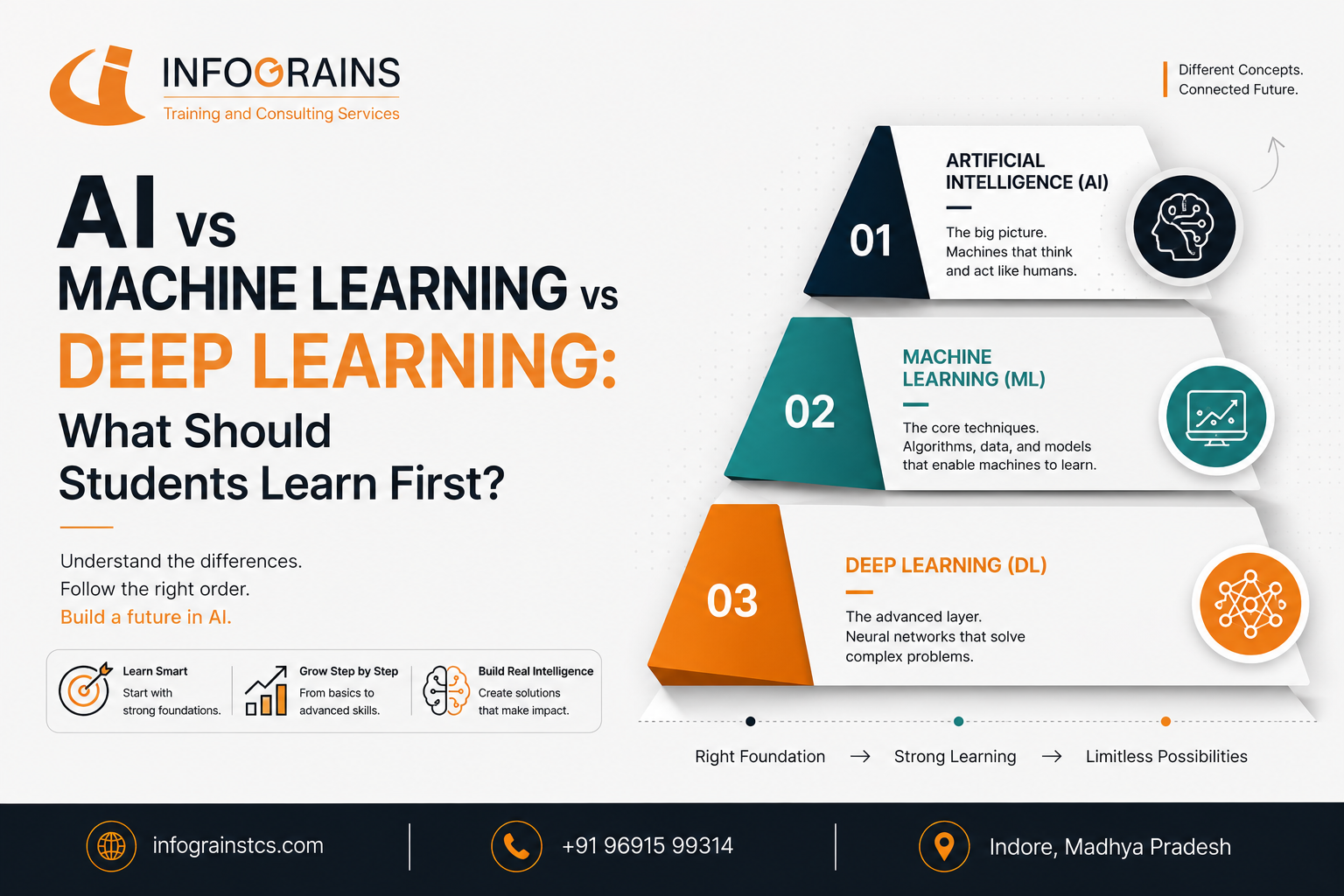
The confusion usually comes from treating these as separate, competing technologies. They're not — they're nested inside each other, each narrower than the last.
Artificial Intelligence
The overall goal: machines that can reason, plan, perceive, and understand language.
Machine Learning
Systems that learn patterns from data instead of following manually written rules.
Deep Learning
Multi-layered neural networks, especially strong on images, audio, and text.
AI vs ML vs Deep Learning: Comparison
| Aspect | AI | Machine Learning | Deep Learning |
|---|---|---|---|
| Scope | Broad field/goal | Approach within AI | Technique within ML |
| Data needed | Varies | Moderate, structured | Large, often unstructured |
| Hardware | Varies | CPU usually enough | GPU strongly recommended |
| Beginner curve | Abstract to start with | Well-defined starting point | Steeper — builds on ML |
How We Got Here: A Brief History of AI, ML & Deep Learning
Drag the marker across the decades to see how the field actually evolved — it wasn't a straight line.
The Idea of AI
Alan Turing proposes the Turing Test. Early AI research focuses on symbolic, rule-based reasoning rather than learning from data.
Should Students Learn AI, ML, or Deep Learning First?
Start with machine learning fundamentals — not AI as an abstract subject, and not deep learning before its prerequisites are solid.
Deep learning builds directly on ML concepts like loss functions and model evaluation — skip those and you'll relearn them mid-way through neural networks anyway.
Fundamentals vs. Specialization — Find the Balance
Every learner leans one way early on. Drag the handle and see where the balance actually sits at different stages of learning.
Build Your AI Foundation, One Block at a Time
Drag each block into the order they should be learned — foundation at the bottom, most advanced on top.
What Should You Learn — Right Now?
Drag the marker to your current stage and see what a focused path looks like from there.
Complete Beginner
Start with Python and basic statistics — no ML or AI concepts needed yet, just comfort writing and reading code.
The Full Roadmap
Python & Math Foundations (3–4 weeks)
Python basics, NumPy/pandas, and enough statistics and linear algebra to understand the algorithms.
Core Machine Learning (6–8 weeks)
Regression, classification, model evaluation, and 2–3 small end-to-end ML projects.
Deep Learning Fundamentals (4–6 weeks)
Neural network basics, one framework (TensorFlow or PyTorch), and a simple classification project.
Specialize & Build a Portfolio
Pick a direction — computer vision, NLP, or applied ML — and build 2–3 portfolio-ready projects.
Is It Machine Learning or Deep Learning? Sort These Real Examples
Drag each chip into the bucket you think it belongs to. This is the fastest way to actually feel the difference, not just read about it.
AI and Machine Learning Careers for Students
- Machine Learning Engineer — builds and deploys ML models into production systems.
- Data Scientist — uses statistics and ML to extract insights and build predictive models.
- AI/ML Trainee — a common fresher entry point at IT services and product companies.
- Deep Learning / Computer Vision Engineer — specializes in neural-network-based systems.
How AI Is Transforming Web Development in 2026
Power BI Course in Indore: Career Guide
How to Get an IT Job Without Experience
Want a guided path into AI & Machine Learning?
Infograins TCS runs structured AI/ML training for students and freshers — Python, ML, and deep learning fundamentals with real projects.
Explore AI/ML ProgramsFrequently Asked Questions
What is the difference between AI, ML, and deep learning?
AI is the broad goal of intelligent machines. ML is a subset of AI where systems learn from data. Deep learning is a subset of ML using layered neural networks.
Should I learn AI or machine learning first?
Learn machine learning first — it's the concrete, learnable foundation almost every AI application is built on.
Is deep learning harder than machine learning?
Generally yes — it requires solid ML fundamentals first, plus neural network architecture and GPU-based training concepts.
What is the best roadmap to learn AI and machine learning?
Python and statistics fundamentals, then core ML algorithms and projects, then deep learning frameworks — typically four to six months.