
The world has fundamentally changed. These days, artificial intelligence and machine learning are not just futuristic ideas found in research labs; they are the engines of business transformation in every conceivable industry. Understanding how AI and ML are changing industries in 2026 is becoming essential as organizations adopt intelligent technologies across operations. From healthcare diagnostics to financial fraud detection, from personalized shopping experiences to autonomous vehicles, AI and ML have become the essential technologies of our era.
Despite the rapid acceleration of AI adoption, there are still few skilled professionals. Employers are in dire need of talent and are rewarding those with these skills with unheard-of opportunities and high salaries. This is a fantastic window of opportunity for aspirational people who are prepared to make the necessary training investment in AI & ML and begin learning artificial intelligence for beginners or advancing existing technical knowledge.
This comprehensive guide explores the most sought-after AI and ML skills in 2026, reveals what’s capturing learner attention worldwide, explains why these skills are more important than ever, and shows why Infograinstcs is the perfect partner for mastering these game-changing technologies for those planning to Learn AI & ML in 2026.
1. High-Demand AI & ML Courses in 2026
Machine Learning Fundamentals
AI learning applications begin where systems learn patterns from data and make decisions automatically. In this course, you explore core learning approaches such as supervised learning for prediction tasks, unsupervised learning for pattern discovery, and reinforcement learning for adaptive decision-making. The course introduces important algorithms such as decision trees, random forests, support vector machines, and linear regression, helping you apply them in real scenarios.
Deep Learning & Neural Networks
Deep learning is superior at complex tasks involving speech, images, and unstructured text, whereas traditional machine learning performs well with structured data. Deep learning makes use of multi-layered artificial neural networks that are modeled after the human brain and are capable of recognizing complex patterns. Cutting-edge research jobs and roles in autonomous systems, advanced robotics, and medical imaging are made possible by this specialization.
Natural Language Processing (NLP)
NLP enables machines to understand, interpret, and generate human language. This field has exploded with the rise of conversational AI, chatbots, sentiment analysis tools, and language translation services. You’ll learn about tokenization, word embeddings, transformers, BERT, GPT architectures, and how to build applications that can summarize documents, answer questions, generate content, and extract insights from text. With businesses desperate to automate customer service and extract value from textual data, NLP specialists are among the most sought-after professionals in tech.
Generative AI & Large Language Models
The hottest field in technology today. Generative AI creates new content—text, images, code, music, and more—based on training data. Learn to work with large language models like GPT, understand prompt engineering, fine-tune models for specific tasks, and deploy generative AI solutions ethically and effectively.
AI for Business & Data Science
Not everyone needs to build AI from scratch—many professionals need to apply artificial intelligence to solve business problems. This course focuses on using AI and ML tools to extract insights from data, build predictive models for forecasting and decision-making, create recommendation systems, and implement AI solutions using platforms like AutoML. These applied capabilities are part of the AI skills needed for 2026 jobs, especially for analysts, managers, and entrepreneurs.
2. What Topics People Are Actively Searching and Learning
Understanding current trends helps you align your learning with market demands:
AI-Powered Automation Driven by AI
Professionals from all sectors are looking for ways to use AI to get rid of tedious work. Workflow automation, AI-enhanced productivity tools, automated data entry, and intelligent document processing have all seen explosive growth in popularity.
Practical project-based learning
Theory without application doesn’t land jobs. Learners specifically seek courses that include hands-on projects they can showcase: building recommendation engines, fraud detection systems, sentiment analysis tools, image classifiers, and predictive models they can add to their portfolios.
AI Ethics and Responsible AI
As AI becomes more powerful, concerns about bias, fairness, privacy, and societal impact have grown. Professionals want to understand not just how to build AI but how to build it responsibly.
AI for Specific Industries
Healthcare professionals want AI for medical imaging and diagnosis, financial professionals seek AI for trading and risk assessment, marketers want AI for personalization and content creation, and manufacturers need AI for quality control and predictive maintenance.
3. Why AI & ML Skills Are Critical in 2026
Economic Necessity
The AI skills gap has reached crisis levels. Major companies report that unfilled AI positions cost them millions in lost productivity and competitive disadvantage. For individuals, this translates to exceptional job security, premium salaries, and the ability to negotiate favorable work conditions.
Industry Transformation Across All Sectors
Artificial intelligence has become a major driver of modern industries. The healthcare industry applies AI to diagnosis and medication development. The financial sector applies AI to fraud analysis. The retail sector applies AI to inventory management and product suggestions. The manufacturing sector applies AI to predictive maintenance and quality assurance. The agricultural sector applies AI to crop monitoring and yield optimization. The entertainment industry produces content using AI. Every industry requires AI knowledge.
Automation Resilience
While AI will automate many jobs, it will create countless opportunities for those who can work with these systems. AI learning doesn’t just secure your current position—it positions you as an architect of automation. The professionals who understand AI will design, deploy, and manage the systems that reshape work.
Entrepreneurial Empowerment
Innovation has been democratized by AI. Now, an individual developer with the skills to work with ML can develop applications that would have needed huge teams and investment not so long ago. Whether you want to start a business, develop AI tools for your sector, or start freelancing as an AI consultant, these skills will empower you to become an entrepreneur.
Future-Proof Career Development
Technology evolves rapidly, but artificial intelligence and machine learning represent fundamental capabilities that will be more important in the future. Unlike learning a specific skill set that might become obsolete, understanding the principles of machine learning provides adaptable knowledge that transfers across platforms and applications.
Global Opportunities
AI skills are among the most portable in today’s economy. Remote work in AI/ML is not just accepted but often preferred, allowing you to work for companies anywhere in the world. This geographical flexibility means you can access global salary levels regardless of your physical location.
Innovative Leadership
AI professionals don’t just execute tasks—they identify opportunities, design solutions, and drive strategic decisions. These skills position you for leadership roles where you get to decide how organizations should use technology, rather than just following orders.
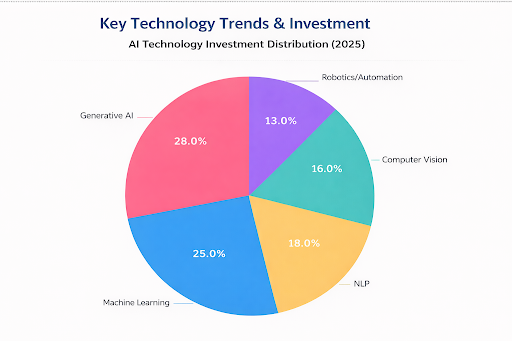
4. AI & Machine Learning: 5-Year Impact Analysis
Market Growth & Digital Modernization (2020–2026)
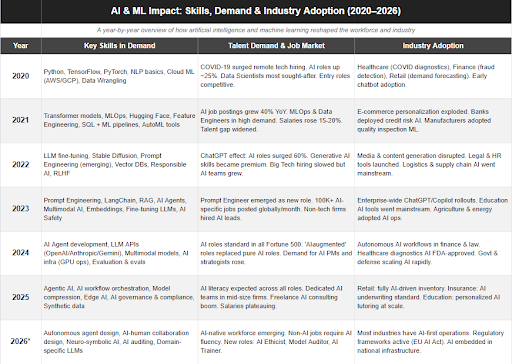
The Last Five Years: Witnessing Unparalleled Transformation. The evolution of artificial intelligence and ML systems has been tremendous, from being new technology to becoming the pillars of the current business landscape. This analysis covers the explosive market development of AI systems, the extent of their industry-wide acceptance, and the transformation that AI/ML has brought to the global market.
AI & ML Impact: Skills, Demand & Industry Adoption (2020-2026)
5. Modernization Impact Across Industries
Healthcare
AI-based diagnostics, medicine discovery, personalized medicine, and predictive patient care have reduced diagnosis times by 60%.
Finance
The accuracy of fraud detection increased by 95%, while algorithmic trading, risk assessment, and customer service automation revolutionized the industry.
Manufacturing
Predictive maintenance reduced downtime by 70%, quality control automation, and smart factory operations.
Automotive
Self-driving cars, driver assistance systems, automation in manufacturing, and predictive maintenance systems.
Technology
Cloud AI services, developer tools, AI-powered applications, and infrastructure modernization.
Education
Personalized learning paths, automated grading, intelligent tutoring systems, and adaptive learning platforms.
Agriculture
Precision farming, crop monitoring, yield prediction, and automated irrigation systems. Productivity increased by 35% as a result of these measures.
6. Key Insights from 5 Years of AI Evolution
1.Exponential Growth: The AI market grew nearly 4x from $62.4B to $305.9B, exceeding initial projections.
2.Generative AI Revolution: 2023-2025 saw explosive growth in generative AI, transforming content creation, coding, and creative industries.
3.Enterprise Mainstreaming: 75% of enterprises now use AI in production, up from 15% in 2020.
4.Skills Gap Crisis: Demand for AI talent increased 383%, creating urgent need for training programs.
5.Cloud-First AI: 82% of AI workloads now run on cloud infrastructure, enabling rapid scaling.
6.ROI Validation: Organizations report average ROI of 250% within 18 months of AI implementation.
7. Emerging Trends for the Next 5 Years
1. Artificial General Intelligence (AGI) Development: Significant progress toward more generalized AI systems capable of human-like reasoning across multiple domains.
2. AI-Powered Automation at Scale: Complete business process automation, from customer service to strategic decision-making, will become standard practice.
3. Quantum AI Integration: Quantum computing will enhance AI capabilities, enabling unprecedented computational power for complex problems.
4. Hyper-Personalization: AI will deliver individualized experiences across all customer touchpoints, from healthcare to entertainment.
5. Sustainable AI: Focus on energy-efficient AI models and green computing practices to reduce environmental impact.
6. AI Regulation & Governance: Comprehensive regulatory frameworks will emerge globally to ensure responsible AI development and deployment.
8. Why Now Is the Time to Learn AI & ML in 2026
The data clearly demonstrates that AI and ML are not temporary trends but the future of tech, which will decide how businesses operate and compete. The 5-year trajectory from 2020 to 2025 shows:
● Nearly 400% market growth with no signs of slowing
● 75% enterprise adoption creating massive demand for skilled professionals
● Average salaries increasing 59% for AI specialists
● Every major industry undergoing AI-driven transformation
● 5.8 million job openings in AI-related roles globally
Whether you’re a student, working professional, or career switcher, acquiring AI and ML skills is no longer optional—it’s essential. An IT training center like Infograinstcs positions you to Learn AI & ML in 2026
The question is not whether AI will transform your industry—it already has. The question is whether you’ll be leading that transformation or struggling to keep up.
9. Why Choose Infograinstcs for Your AI & ML Journey
1. Industry-Aligned Training Approach
At Infograinstcs, we provide the best AI Certification Program and machine learning programs created and regularly updated by industry professionals working at leading tech companies, startups, and research organizations. We focus on teaching current tools, techniques, and real-world applications—not outdated textbook theory. This ensures you gain practical skills that employers are actively looking for today.
2. Hands-On, Project-Focused Learning Approach
Infograinstcs focuses on practical learning, not just theory. Our AI Certification Program and ML Certification Program emphasize real-world projects where you build recommendation systems, image classifiers, NLP applications, and predictive models and deploy solutions. By the end of the program, you’ll have a strong portfolio that shows real skills to employers.
3. Learn from Industry Experts
Our trainers aren’t just teachers—they’re active AI professionals working in tech companies, startups, and research environments. They share real industry insights, practical challenges, and proven solutions from real projects. You learn from experts who’ve built scalable systems, deployed models, and solved real-world business problems.
4. Comprehensive Learning Paths for Every Level
Whether you’re an absolute beginner with no programming experience or a developer looking to specialize in AI, Infograinstcs offers structured learning paths. Our foundational courses start with programming basics and mathematical concepts, progressing systematically to advanced topics. We don’t assume prior knowledge, but we also don’t waste time on unnecessary content.
5. Career Support and Industry Connections
Completing coursework is just the beginning. Infograinstcs, your trusted IT training institute, provides comprehensive career support, including resume optimization for AI roles, portfolio development guidance, mock technical interviews, coding challenge preparation, and access to our network of hiring partners actively recruiting AI talent. We measure success by your career outcomes, not just course completions.
6. Affordable Excellence with Transparent Pricing
Quality AI learning and machine learning education shouldn’t require crushing debt. Infograinstcs offers competitive pricing significantly below traditional university programs while delivering superior practical preparation. We provide flexible payment plans, corporate training packages, and group discounts. Our focus is making AI education accessible to everyone with the motivation to learn.
7. Recognition & Certification
At Infograinstcs, our completion certificates highlight practical, job-ready skills that employers value. Each program focuses on hands-on projects, real-world problem solving, and portfolio development so learners can confidently showcase their abilities. Along with certification, you gain industry exposure, interview preparation support, and demonstrable experience that strengthens your professional profile and career opportunities.
10. Certification at Infograinstcs
Upon completing training at Infograinstcs, learners receive certification that reflects their participation in structured learning and practical project work. These credentials support those seeking AI certification for working professionals and those exploring recognized skill validation pathways comparable to Best AI certification programs 2026 available in the learning ecosystem.
Infograinstcs certifications are designed to support professional presentation rather than serve as just a completion record. They can be included in resumes, portfolios, and professional networking profiles to demonstrate continued skill development.
Key aspects include:
- Recognition of course completion and project involvement
- Alignment with industry-relevant skill exposure
- Support for resume building and interview preparation
- Useful documentation for academic or career progression
Although certification is one element of career advancement, its worth rises when paired with practical experience, portfolio projects, and lifelong learning. To ensure that students graduate with both documented recognition and practical familiarity with the subject matter, Infograinstcs places a strong emphasis on this balanced approach.
11. Frequently Asked Questions
1. Who can join the AI & ML course?
=Students, graduates, and working professionals interested in data or AI can join. Basic programming knowledge is helpful but not mandatory.
2. What skills will I learn?
=You’ll learn data processing, model building, and problem solving using AI techniques. Emphasis is on practical application.
3. Do I need expensive computer hardware to learn AI/ML?
=No. You can learn using a regular laptop. Infograinstcs students use cloud-based tools that provide access to powerful computing resources, so costly hardware isn’t required.
4. What career roles can I pursue?
=Opportunities include AI developer, data analyst, or ML practitioner roles. Skills apply across multiple industries.
5. What industries use AI skills?
=AI is widely used across healthcare, finance, retail, and more. These skills are applicable in many professional fields. Learning AI broadens career possibilities.
6. Can students from non-IT backgrounds join?
=Yes, students from various backgrounds can enroll. The program introduces core concepts in an accessible way. Dedication and interest matter more than prior experience.
7. How do I start learning today?
=You can reach out through the Infograinstcs website or inquiry channels. The team will guide you through available options. Enrollment steps are explained clearly.
Conclusion
Artificial intelligence and machine learning skills have become mandatory for a successful career in 2026. The change happening across industries has created a huge skills gap, making this an ideal time to build expertise aligned with evolving workforce expectations. Developing capabilities in modeling, neural approaches, NLP, and generative technologies strengthens long-term resilience and opportunity.
Choosing the right learning partner matters. When searching for an IT training institute, consider one that focuses on hands-on exposure and industry relevance so you are job-ready beyond certification. Flexible learning options make it easier to Learn AI & ML in 2026 regardless of starting point.
The best time to take action is now. Investing in AI learning and machine learning skills positions you at the cutting edge of innovation and prepares you to take advantage of global opportunities shaped by intelligent technologies.