
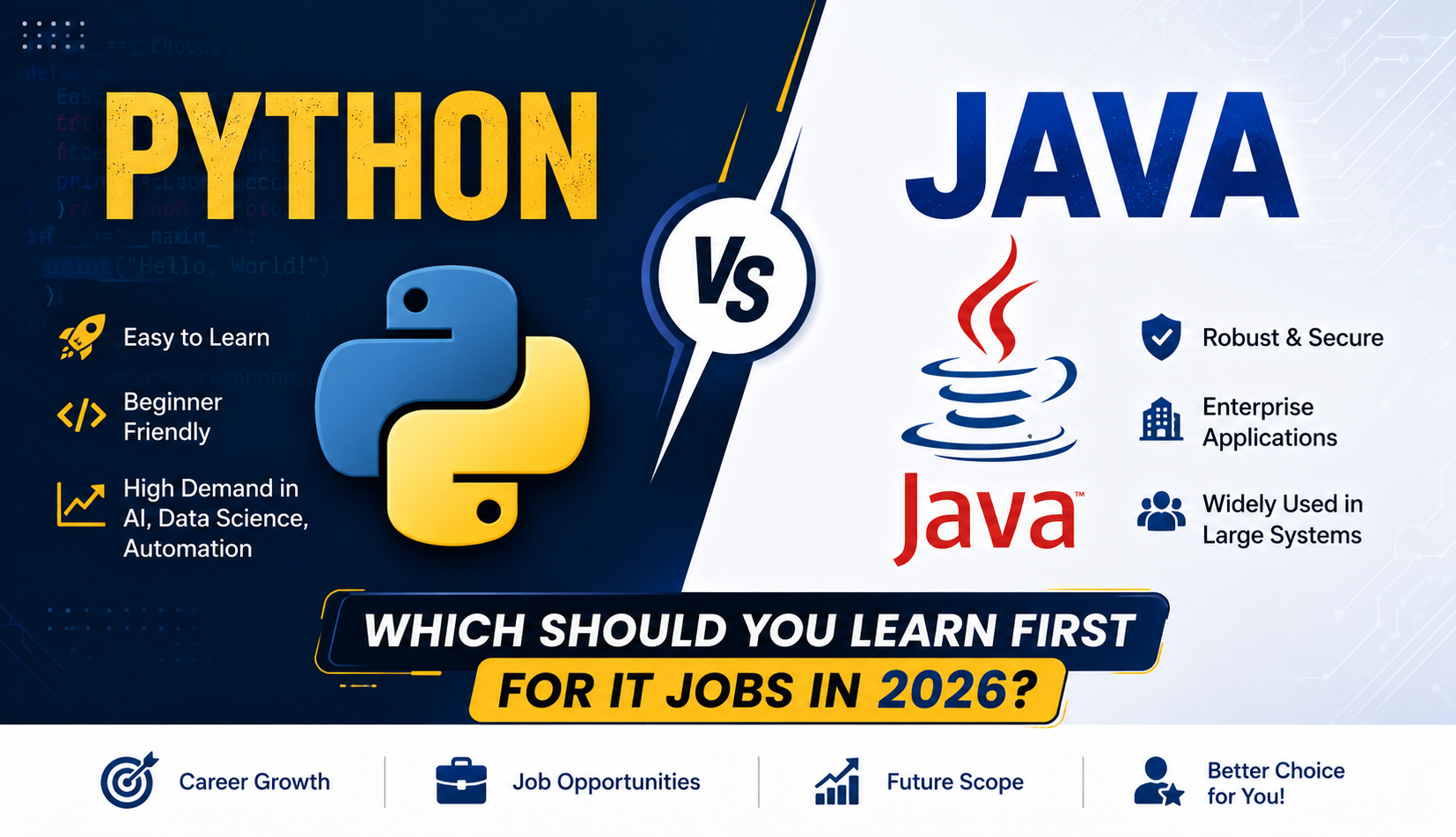
Python vs Java: Which Should You Learn First for IT Jobs in 2026?
What You Are Actually Choosing
Before comparing job counts and salaries, understand what these two languages were built for. They solve different problems — and that shapes everything: the syntax, the ecosystem, the career path, and the type of company that hires for each.
Python was designed to be readable, fast to write, and easy to prototype with. It reads almost like English. You can build a working machine learning model, a data pipeline, a web scraper, or an API in Python in a fraction of the time the same task would take in Java. That simplicity is its greatest strength — and, occasionally, a limitation in massive enterprise codebases that need rigid structure.
Java was designed for reliability at scale. It runs on the Java Virtual Machine (JVM), which means Java code runs on any operating system without modification. Banking systems, airline reservation platforms, and logistics software have been built in Java for decades. In 2026, Java still powers a disproportionate share of India's backend enterprise infrastructure.
One thing that genuinely confuses freshers: Python and Java are rarely competitors in the real world. Companies do not usually sit in a boardroom choosing between them. A data science team uses Python. A backend banking team uses Java. The real question is: which ecosystem do you want to work in?
Job Market Reality in India 2026
India's IT hiring in 2026 is shaped by two forces: the AI and Data Science explosion, and the continued demand for enterprise software engineering. Both languages benefit — but in different sectors.
| Metric | Python | Java |
|---|---|---|
| Open jobs on Naukri (India) | 1,20,000+ | 95,000+ |
| Top hiring sectors | AI/ML, Data Science, Backend APIs, Automation | Enterprise apps, Android, Banking, ERP |
| Common job titles | Python Developer, Data Analyst, ML Engineer | Java Developer, Android Dev, Backend Engineer |
| Fresher-friendly entry? | ✅ Very High | ✅ High |
| Remote work availability | ✅ Very High | High |
Python edges Java in raw volume because the AI/ML boom runs on Python. However, Java's roles tend to sit inside larger, more stable employers — banks, MNCs, and established IT services firms — which often offer better job security and structured growth paths for freshers.
One important 2026 trend: Python + Java combinations are increasingly common on job descriptions. Many backend teams write core business logic in Java and use Python for scripting, automation, and ML integrations. Being comfortable in both, even at a basic level, is a genuine advantage as you grow.
Salary Comparison: Python vs Java in India 2026
| Experience Level | Python Developer | Java Developer |
|---|---|---|
| Fresher / Intern (0 yr) | ₹2.5 – 4.5 LPA | ₹2.5 – 4.5 LPA |
| Junior Developer (0–1 yr) | ₹3.5 – 6 LPA | ₹3.5 – 6 LPA |
| Developer (1–3 yr) | ₹5 – 10 LPA | ₹5 – 10 LPA |
| Specialist (3–5 yr) | ₹9 – 18 LPA | ₹8 – 16 LPA |
| Senior / Lead (5+ yr) | ₹15 – 30 LPA | ₹14 – 28 LPA |
The honest takeaway: at entry level, there is virtually no salary difference. The language does not determine your starting salary — your skills, projects, and communication do.
The gap opens at the specialisation stage. Python developers who move into Machine Learning Engineering or AI product development can reach higher packages faster because these roles are newer and less saturated with experienced talent. Java developers who build expertise in Spring Boot microservices or enterprise architecture follow a slightly slower but extremely stable upward path — with strong demand at India's largest IT employers.
Which is Easier to Learn as a Beginner?
This question has an almost universally agreed-upon answer: Python is significantly easier to start with.
Python's syntax is minimal and readable. You do not need to declare data types explicitly. You do not need to write boilerplate class structures before printing "Hello, World." A complete beginner can write their first useful script — a data reader, a basic web scraper, an API call — within days of starting.
Java, by contrast, is strongly typed, verbosely structured, and requires understanding Object-Oriented Programming (OOP) concepts right from day one. This is not a criticism — it is by design. Java forces you to think in a structured way, which pays off enormously when you work on large teams building complex software. But it makes the first four to six weeks harder for people with no coding background.
Practical implication: If you are new to programming, Python's gentler curve means you will build your first working project faster — which is critical for motivation and portfolio-building. If you already have basic C or C++ from college, Java's initial steepness becomes much more manageable.
Career Paths: Where Each Language Takes You
The language you choose determines the type of career you are building — not just the job title. Here is where each path realistically leads:
🐍 Python Career Paths
- Data Scientist / ML Engineer ₹10 – 35 LPA at senior levels
- Backend Python Developer ₹6 – 18 LPA (Django / FastAPI)
- Data Analyst / Business Analyst ₹4 – 10 LPA
- DevOps / Automation Engineer ₹8 – 20 LPA
- AI Product Developer Fastest-growing path in 2026
☕ Java Career Paths
- Backend Java Developer ₹5 – 18 LPA (Spring Boot / microservices)
- Android Developer ₹5 – 16 LPA (Java + Kotlin)
- Enterprise Software Engineer ₹5 – 20 LPA — high job security
- Java Full Stack Developer ₹4.5 – 16 LPA — most-hired in IT services
- Software Architect ₹20 – 35 LPA long-term ceiling
Head-to-Head: Python vs Java for Freshers in 2026
| Factor | Python | Java |
|---|---|---|
| Ease of Learning | ✅ Easier — beginner-friendly syntax | Steeper — OOP required from start |
| Job Volume (India 2026) | ✅ 1.2L+ open roles | 95K+ open roles |
| Fresher Entry Salary | ₹2.5 – 4.5 LPA | ₹2.5 – 4.5 LPA |
| Senior Salary Ceiling | ₹25 – 30 LPA (AI/ML path) | ₹22 – 28 LPA (architecture path) |
| Best For | Data Science, AI, Automation, Startups | Enterprise, Banking, Android, MNCs |
| Future-Proof vs AI? | ✅ Very High — IS the AI language | High — enterprise demand stable |
| Freelance Potential | ✅ High | Moderate |
| Job-Ready Timeline | 4 – 6 months | 5 – 7 months |
| Best Industries | Tech startups, AI companies, D2C | TCS, Infosys, BFSI, MNCs |
| Used in Data Science? | ✅ Yes — dominant language | No |
6-Month Python Learning Roadmap for IT Jobs 2026
Variables, data types, conditionals, loops, functions, and file handling. Build a command-line calculator and a basic web scraper.
Object-Oriented Python (classes, inheritance, polymorphism), NumPy, and Pandas for data manipulation. Build a dataset analyser.
Web path: Django or FastAPI — build a REST API with authentication. Data path: Scikit-learn and Seaborn — build a classification model.
SQL (MySQL/PostgreSQL), SQLite with Python, GitHub workflows, and third-party API integrations.
Build one complete end-to-end project — a data dashboard, web app, or deployed ML model. Document it on GitHub so it functions as live portfolio evidence.
DSA in Python (arrays, strings, sorting), mock technical interviews, resume building, LinkedIn optimisation, and 10+ applications per week.
4 Mistakes Freshers Make When Learning Python or Java
Watching tutorials is not learning. The only way to genuinely learn programming is to write broken code, debug it, and eventually make something that runs. Every week of training should produce something you built — however small.
Most freshers dread DSA. Most companies test DSA. You cannot skip it. The good news: Python makes DSA problems easier to write — one more reason it is the better starting language for beginners.
Your friend's goals may be completely different from yours. If they want MNC enterprise software, Java is right for them. If you want AI or a startup, Python is right for you. Base the decision on your target, not theirs.
A course gives you structure. The real learning happens after — through projects, hackathons, open-source work, and internships. Students who keep building after the course ends get hired fastest.
Why Choose Infograins TCS for Your Training in Indore?
Updated quarterly based on what local companies — TCS, Infosys, YASH Technologies, Crystal IT Park startups — are actually asking in interviews. Not 2018 content in 2026.
Every module ends with a mini-project. Graduate with 3–5 deployable GitHub projects, not just a certificate and a folder of tutorial files.
Faculty who have built real production systems in Python and Java. They teach what companies actually use — not just what is in textbooks.
Resume reviews, mock technical interviews, HR prep, and direct connections with hiring companies in Indore, Bhopal, and beyond. Over a decade of placements.
Frequently Asked Questions
Which is better for freshers — Python or Java in 2026?
For freshers with no programming background, Python is the better starting point because of its simpler syntax and faster path to building real projects. For freshers who already have some coding experience and want to target large enterprise companies or Android development, Java is an equally strong choice. The key is matching the language to your target career — not picking the one with a better marketing page.
Can I get a job with only Python in 2026?
Yes. Python alone — combined with a strong project portfolio, consistent DSA practice, and clear communication — is sufficient for your first IT job. Employers hiring Python developers span the full range from early-stage startups to global product companies. You do not need Java as well to get started.
Which language pays more — Python or Java?
At entry level, salaries are nearly identical at ₹2.5–4.5 LPA. At senior levels, Python developers in AI/ML roles can edge slightly higher — but Java developers specialising in enterprise architecture and system design are not far behind. Specialisation matters far more than the language once you are past the 3-year mark.
How long does it take to learn Python well enough to get a job?
With focused daily practice and structured training, most students are interview-ready in 4–6 months. This assumes you are actively building real projects alongside the learning — not just watching videos. Students who only do tutorials without building take considerably longer.
Is Java still in demand in India in 2026?
Absolutely. Java underpins India's banking infrastructure, a large share of major IT services firms, and a significant portion of Android development. Java is not declining — Spring Boot microservices and Kotlin are actively extending its relevance and keeping demand strong well into 2026 and beyond.
Should I learn both Python and Java?
Learning both is valuable long-term but is not necessary for your first job. Start with one, get hired, and expand from there. Many developers learn their second language on the job. Attempting both simultaneously typically leads to confusion and slower progress across both.
The Verdict
Python and Java both lead to strong, well-paying IT careers in 2026. The right choice comes down to your goal, not a language's ranking on a list.
You want AI, Data, or Startups
- You are completely new to programming
- You want data science, ML, or automation
- You are targeting startups or product companies
- You want the fastest path to your first live project
You want Enterprise or Android
- You want banking, ERP, or large MNC roles
- You are targeting Android development
- You prefer a language that teaches discipline early
- You already have some C/C++ background
The biggest mistake you can make is spending another six weeks researching instead of enrolling and starting. The IT job market in India rewards people who build skills early, consistently, and practically. Whether you choose Python or Java, the most important variable is not the language — it is the quality of your training, the depth of your projects, and your willingness to keep building after the course ends.