
Is Generative AI Mandatory in 2026? Yes. The era of the “Junior Coder” who writes basic syntax is over. Tools like GitHub Copilot and Gemini have automated 60% of entry-level tasks (documentation, unit testing, bug fixing).
Key Takeaways:
- The Shift: Companies in 2026 don’t hire freshers to write code; they hire “AI Architects” to orchestrate AI agents, build RAG pipelines, and design secure systems.
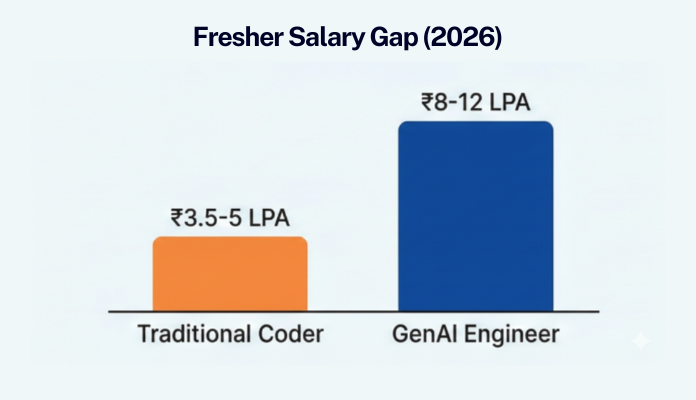
- The Salary Gap: A traditional Java/Web Developer fresher earns ₹3.5–5 LPA. A GenAI-skilled fresher (who knows Agentic AI) commands ₹8–12 LPA, even in Tier 2 cities.
- The Roadmap: Stop memorizing syntax. Start mastering Prompt Orchestration, Vector Databases (Pinecone), and Agentic Workflows (LangChain).
- The Solution: YouTube tutorials often lack production standards (security/ethics). To be interview-ready, you need live project experience.
Next Step: Future-proof your career by joining Infograins TCS, the Best IT Training institute in Indore, where we teach you to build real-world AI solutions, not just “Hello World” apps.
Introduction
The tech environment you are entering as a 2026 graduate is completely different from what it was three years ago. It is officially the end of the days of the “standard coder”—the beginner who can create a simple loop, understand Java syntax, and answer a few LeetCode tasks.
This is not meant to scare you. This is what we’re saying to prevent your career from beginning.
We witnessed the earthquakes in 2024: layoffs and hiring freezes. The earthquake has subsided by 2026, and a new foundation has been constructed.
Today’s hiring managers are not searching for “Junior Developers” to fix small problems or write boilerplate code. Why? Because AI agents, such as GPT-5 class models and Gemini 3 Pro, can do that for free in a matter of seconds.
So, where does that leave you?
It leaves you with a choice. You can either be the engineer who competes with AI (and loses), or the engineer who orchestrates AI (and wins big). The industry doesn’t have a shortage of jobs; it has a shortage of AI-Enabled Engineers. Companies are desperate for freshers who understand how to integrate LLMs, build RAG pipelines, and deploy agentic workflows.
Even in Tier 2 tech hubs, the shift is visible. Students flocking to the Best IT Training institute in Indore are asking one question: “How do I move beyond basic coding?” They realize that standard curriculums are no longer enough.
This guide is your blueprint. We will strip away the hype and give you the raw facts: why Generative AI is mandatory, how it impacts your salary, and the exact roadmap you need to follow to stay relevant.
Why is Generative AI mandatory for CS Freshers in 2026?
Since 60% of entry-level coding tasks, such as template creation, documentation, and unit testing, have been automated, learning generative AI is required.
Recruiters in 2026 give preference to “AI Architects” that are capable of creating complicated systems in addition to writing syntax using tools like LLMs, RAG, and Agents.
What Generative AI Actually Means in 2026
Generative AI is still viewed by most students as simply “asking ChatGPT to write an email.” You’re already behind if that’s how you define yourself.
Generative AI has developed into the foundation of contemporary software architecture in the field of computer science. Text-to-text and text-to-image are no longer the only options. The era of multimodal and agentic AI is upon us in 2026.
The Three Pillars of GenAI for Engineers:
- Code Generation & Refactoring: It’s not just about writing code; it’s about translating legacy code (e.g., COBOL or older Java) into modern languages (Go, Rust, Python) instantly.
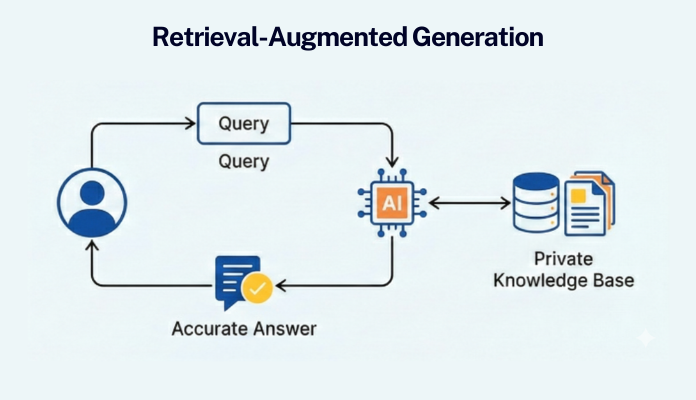
- Retrieval-Augmented Generation (RAG): This is the holy grail for businesses. It involves connecting an AI model to a company’s private data (PDFs, databases, emails) so it can answer questions accurately without “hallucinating.”
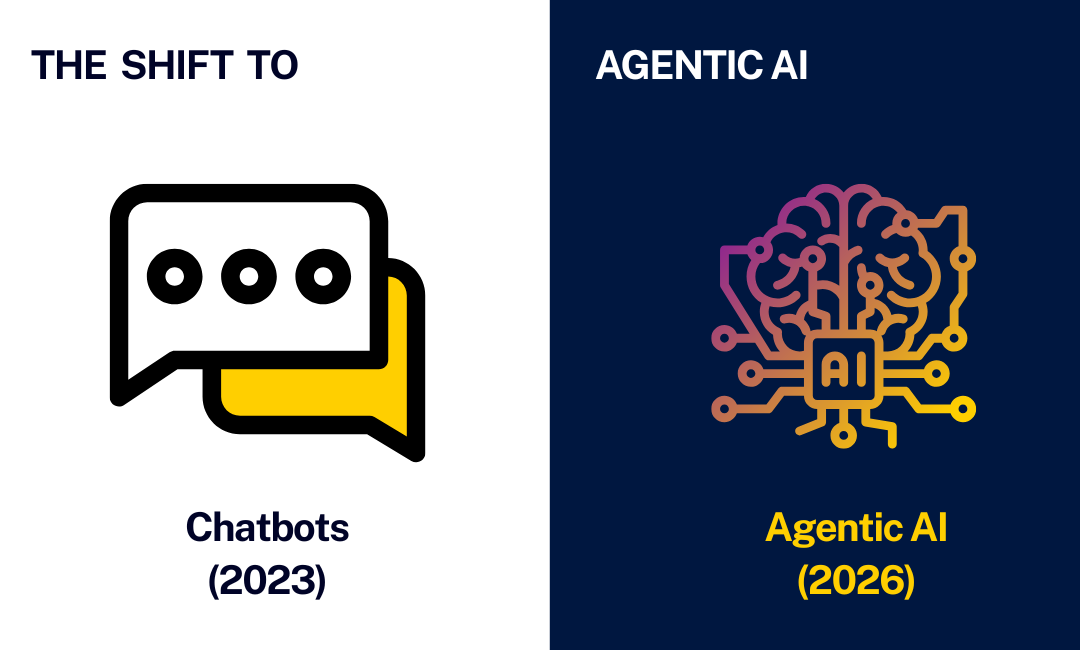
- Agentic Workflows: This is the biggest shift for 2026. AI agents don’t just “talk”; they “do.” They can browse the web, execute code, run tests, and deploy applications with minimal human oversight.
The Difference: Predictive vs. Generative AI
- Predictive AI (Old Era): Analyzes data to guess what happens next (e.g., “Will this user click this ad?”).
- Generative AI (New Era): Creates new data and reasons through problems. It transforms the computer from a calculator into a creative partner.
For a CS fresher, understanding this distinction is key. You aren’t being hired to build models from scratch (researchers do that); you are being hired to apply these models to solve real-world business problems.
The “Junior Trap”: Why Syntax is No Longer Enough
When it comes to the current job market, let’s be brutally honest.
For many years, the “safe path” for a new IT student was straightforward: Get a job as a Junior Developer by learning a language (Python, Java, or C++), learning the syntax by heart, and practicing LeetCode challenges. It would be your responsibility to construct simple functions, address minor errors, and possibly create some documentation.
In 2026, that “safe path” is a trap.
Why? Because tools like GitHub Copilot Workspace, Cursor, and Google Gemini Code Assist have completely automated those tasks.
- Need to write a unit test? AI does it in 3 seconds.
- Need to document your API? AI does it while you type.
- Need to convert a Python script to Go? AI does it instantly.
You are in serious trouble if all you can say is, “I know how to write a for loop in Java,” Compared to a human, an AI agent can write that loop more quickly, more affordably, and with fewer mistakes.
Recruiters who use the New Interview Standard are aware of this. Interviews in 2026 have changed as a result. Doing “reverse a string on a whiteboard” is no longer a requirement. They want to know: “How would you design a system that summarizes 1,000 PDFs using an LLM?”
“How do you stop an AI agent from imagining when talking to a customer?”
Instead of testing for syntactic memory, they are testing for logic and system design. The “Junior Developer” who simply follows instructions is disappearing. The problem-solving “Junior Architect” is becoming more and more popular.
Top 5 Reasons Generative AI is Your Career Rocket Fuel
If the last section scared you, this one should excite you. The shift to AI isn’t just closing doors; it’s opening massive gates for those who are ready. Here is why learning Generative AI is the single best investment you can make for your career in 2026.
Reason 1: The “AI Premium” on Your Salary
Let’s talk about money. In the current market, there is a massive gap between a “Traditional Coder” and a “GenAI Developer.”
- Traditional Fresher (Java/Web Dev): Struggle to find roles, often settling for packages around ₹3.5 LPA to ₹5 LPA.
- GenAI Enabled Fresher: Companies are desperate for people who can build RAG pipelines and AI agents. Starting packages often range from ₹8 LPA to ₹12 LPA, even for fresh graduates.
- Why? Because you are doing the work of three people using AI tools.
Reason 2: You Become a “10x Engineer” Day One
Before AI, building a full-stack application (Frontend + Backend + Database) took a fresher months to learn. With GenAI tools, you can build a Minimum Viable Product (MVP) in a single weekend. You can ask the AI to scaffold the project, write the boilerplate, and even debug the errors. This speed allows you to focus on the product, not the plumbing.
Reason 3: Skip the “Grunt Work”
Usually, freshers spend their first 2 years doing boring tasks — data entry, manual testing, or writing simple scripts. As an AI-skilled engineer, you skip this queue. You jump straight into Architecture. You aren’t writing the code; you are reviewing the code written by the AI. You become a manager of digital workers (agents) right out of college.
Reason 4: Recession-Proof Your Career
When companies cut costs, who do they fire? They fire the “doers”—the people whose jobs can be automated. Who do they keep? They keep the “solvers”— the people who maintain the automation. By becoming an expert in Generative AI, you position yourself as the person controlling the efficiency. You become indispensable.
Reason 5: The “One-Person Unicorn”
This is the most exciting part. You no longer need a team of 10 people to build a startup.
- Need a logo? AI generates it.
- Need a marketing copy? AI writes it.
- Need a mobile app? AI codes it.
- Need legal docs? AI drafts them.
For the first time in history, a CS fresher has the power to build a fully functional business solo. If you have an idea, you don’t need funding; you just need GenAI skills.
Salary Trends 2026: The Reality Check
Let’s examine the numbers and quit speculating. The salary difference between an “AI Architect” (someone who uses GenAI) and a “Code Monkey” (someone who only produces syntax) has grown to a canyon in 2026.
You are entering a crowded market where thousands of students compete for the same ₹3.5 LPA job if you keep to the outdated curriculum, which includes HTML, CSS, basic Java, and a little SQL.
Turning to GenAI, however, puts you in a market where recruiters are competing for your business.
The 2026 Fresher Salary Breakdown (India)
|
Role |
Avg. Package (Tier 1 Cities) |
Avg. Package (Indore/Tier 2) |
Growth Potential |
|
Traditional Developer (Java/Web) |
₹4.0 LPA – ₹6.0 LPA |
₹3.0 LPA – ₹4.5 LPA |
Slow (5-10% hike) |
|
Data Scientist (Old School ML) |
₹6.0 LPA – ₹9.0 LPA |
₹4.5 LPA – ₹7.0 LPA |
Moderate |
|
GenAI Engineer (RAG/Agents) |
₹10.0 LPA – ₹18.0 LPA |
₹7.0 LPA – ₹12.0 LPA |
Explosive (30-50% hike) |
The “Indore Advantage”
Most people are unaware of this, but you don’t have to relocate to Bangalore to make a lot of money these days. A specialized AI ML course in Indore can now provide a higher Return on Investment (ROI) than a costly degree in a metropolis due to remote employment and the growth of tech centers in MP.
Imagine living in Indore, where living expenses are lower, and earning ₹10 LPA. That’s the financial autonomy that GenAI provides.
The Ultimate 2026 GenAI Roadmap: From Zero to Hired
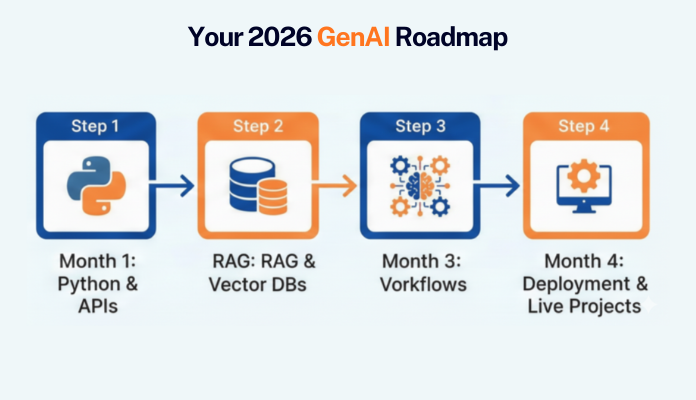
This is not a generic “learn Python” list. This is the exact battle plan to go from a confused student to a hired GenAI Engineer in 4 months.
Month 1: The Foundation (Stop Coding, Start Orchestrating)
- Goal: Shift your mindset from “writing code” to “commanding code.”
- Tech Stack: Python (Advanced), OpenAI API, Gemini API.
- What to Learn:
- Prompt Orchestration: Move beyond “write me an email.” Learn Chain-of-Thought (CoT) prompting to make AI solve complex logic.
- API Integration: Don’t use ChatGPT on the web. Learn to call gpt 5.2 or gemini-3-pro inside your Python script to process data.
- The Reality Check: Most students stop here. To win, you must go deeper.
Month 2: RAG (The Skill That Gets You Hired)
- Goal: Make the AI “smart” about specific data.
- The Problem: ChatGPT doesn’t know your company’s private data.
- The Solution (RAG): Retrieval-Augmented Generation.
- Tech Stack: LangChain, Pinecone (Vector Database), LlamaIndex.
- Project: Build a “Chat with PDF” tool where you upload a 500-page book and ask questions.
- Pro Tip: This is the #1 skill recruiters at any top AI ML training institute in Indore will tell you to master. If you have “RAG Pipeline” on your resume, you skip the queue.
Month 3: Agentic AI (The 2026 Standard)
- Goal: Build AI that does things, not just says things.
- The Concept: An AI Agent can browse the web, run a Python script, save a file, and email it—all without you touching it.
- Tech Stack: LangGraph, CrewAI, AutoGen.
- Project: Build a “Job Application Agent” that scans LinkedIn, rewrites your resume for each job, and drafts a cover letter automatically.
Month 4: Deployment & The “Killer” Portfolio
- Goal: Stop running code in Jupyter Notebooks. Ship it.
- Tech Stack: Streamlit (for UI), FastAPI (for Backend), Hugging Face Spaces.
- The Final Exam: Don’t just show a GitHub link. Show a live link. Send the recruiter a URL to your AI tool and say, “I built this. Try it.”
Watching YouTube videos alone won’t teach you this. You’ll get error messages that Google is unable to resolve. You require mentoring. It’s essential to locate an Indore data science training institute that specializes in Agentic AI and provides live project help if you want to avoid the “Tutorial Hell.”
The Dark Side: Why Self-Learning AI Often Fails
You might be thinking, “Why do I need a course? I can just watch YouTube tutorials.”
This is the most dangerous trap for freshers in 2026. We call it “Tutorial Hell.” You watch a video, copy the code, and it runs. But when you try to build something new, you freeze. Why? Because YouTube teaches you syntax, but it doesn’t teach you production standards.
The “Hidden” Problems with Self-Learning:
- Hallucinations & Security: A YouTube tutorial won’t teach you how to stop an AI from leaking private user data or “hallucinating” false facts. In a real job, this gets you fired.
- Outdated Libraries: GenAI moves so fast that a tutorial from 6 months ago is already obsolete.
- No Live Projects: Recruiters don’t care about your “To-Do List” app. They want to see a deployed RAG pipeline.
This is why serious students are turning to structured learning. Finding an AI ML training institute in Indore that forces you to work on live, messy, real-world data — not just clean datasets — is the difference between passing an interview and failing it.
Real-World Use Cases: What You Will Actually Build
At Infograins TCS, we don’t believe in “Hello World” examples. Here is what our students are building right now (and what you will build too):
- The “HR Resume Parser”: An AI agent that reads thousands of PDF resumes, extracts skills, and ranks candidates automatically for an HR team.
- The “Legal Eagle”: A RAG-based tool where lawyers upload 500-page contracts, and the AI instantly flags risky clauses.
- The “Code Migrator”: An agent that takes old Java code and rewrites it into modern Python, saving companies millions in manual labor.
Even a traditional Data Science training institute in Indore must now upgrade its syllabus to include these GenAI use cases, or their students will be left behind.
Conclusion
You have two choices in 2026.
Path A: The AI revolution is ignored. For a ₹3.5 LPA testing position that may be automated the following year, you compete with 100,000 other freshmen.
Path B: Generative AI is your forte. You enter interviews by showcasing how you can save the business money and time. Since you are an asset rather than a burden, you bargain for a pay of ₹8–12 LPA.
You have an option.
Are you prepared to secure your career’s future? Engineer the revolution instead than simply witnessing it. Start creating your future now by enrolling at Infograins TCS, which is regarded as the Best IT Training Institute in Indore.